June 9, 2026
Sumps and spill buckets at fuel stations: inspection, draining, and spill prevention

Sumps (sealed boxes under each dispenser) and spill buckets (containment containers at each tank's fill point) are the components that detect the most leaks and get ignored the most. In the field, the pattern repeats: a dispenser sump seal degraded over months without inspection, or a cracked spill bucket that accumulated water and fuel until the ATG alarm finally forced opening the lid.
This article covers what they look like when working well, what signs warn that they need intervention, and what a realistic maintenance schedule is for stations operating in Panama.
What they are and where they are
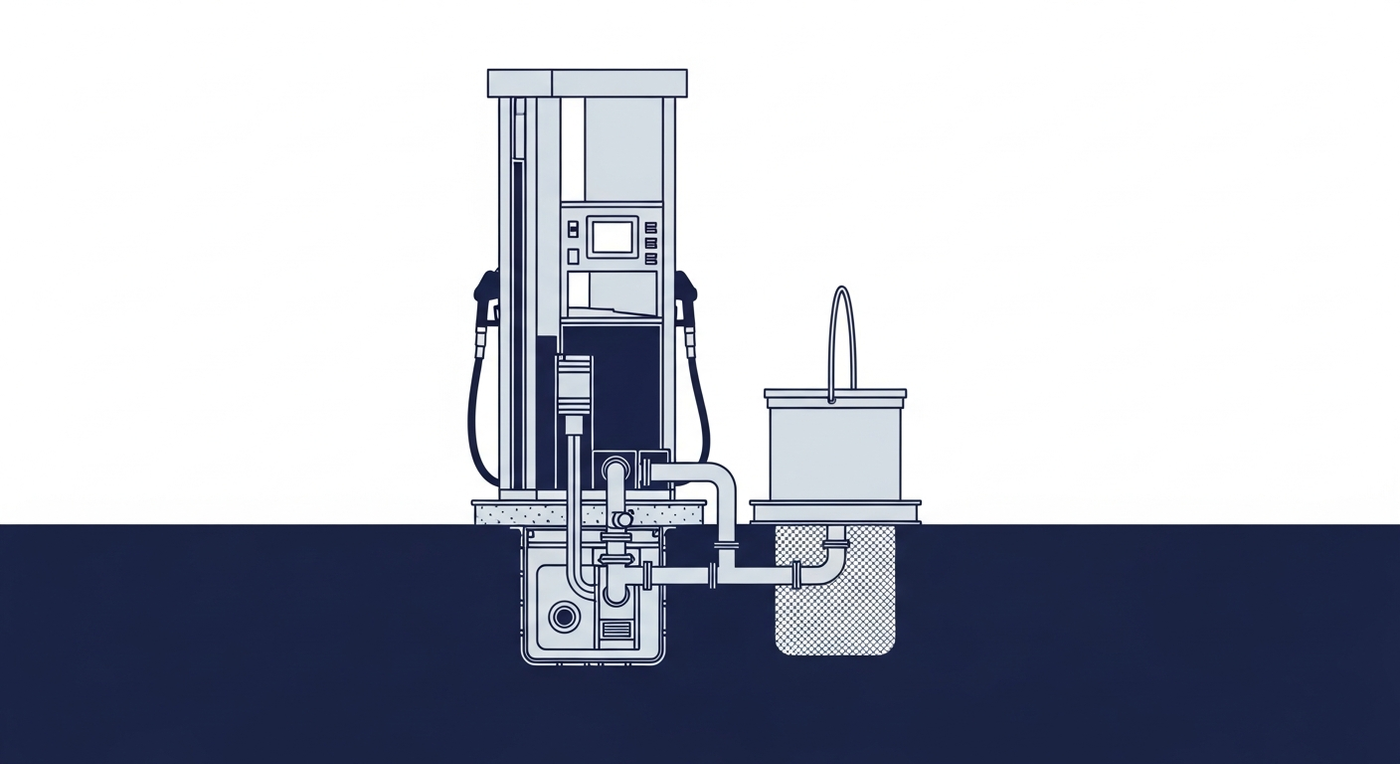
Dispenser sump (under-dispenser containment)
It is a sealed box installed under each dispenser, beneath the concrete slab. Its function:
1. Contain any leak from the dispenser's flex connectors, connections or seals before the product reaches the soil.
2. Allow maintenance access without having to break the slab.
3. Environmentally isolate the critical zone where the meter connects to the underground line.
A modern dispenser has 1 sump per dispenser (or 1 sump split between 2 nozzles depending on the design). The inspection is done by lifting the metal lid visible on the island floor — that's where the sump is.
Spill bucket (containment manhole)
It is the container visible beside each fill cap of the underground tanks. When the tanker truck connects its hose to discharge fuel into the tank, any drip from the connection falls into the spill bucket, not onto the soil.
Typical capacity: 5-15 gallons. Function: contain delivery spills so they do not reach the ground or the storm drain.
Why they fail
Dispenser sumps
Sumps fail due to:
Spill buckets
Spill buckets fail due to:
The signs that cannot be ignored
When a sump or spill bucket is failing, the symptoms are usually subtle but cumulative:
Dispenser sump
| Sign | Probable cause |
|—|—|
| Water accumulated in the sump after any rain | Upper seal or lid allows ingress |
| Gasoline/diesel smell when lifting the lid | Internal flex connector has a subclinical leak |
| Oily stains on the sump walls | The meter or flex connector seal is dripping |
| Rust ring at the bottom | Water standing for weeks/months |
| Flex connector with a visibly cracked cover | Degraded material, urgent replacement |
| Visibly swollen or soft seals | Material not compatible with the current product (E10) |
Spill bucket
| Sign | Probable cause |
|—|—|
| Water accumulated after every rain | The lid does not seal, or the spill bucket has a crack |
| Layer of fuel floating on water | Drips during deliveries were not drained |
| Lid hard to open or stuck | Corroded or deformed hinge |
| Cracked edges of the spill bucket | Damage from hose impacts |
| Bucket full of dirt/debris | Maintenance omitted for a long time |
| Storm drainage falls directly into the bucket | Incorrect slab design, requires civil correction |
How to inspect them correctly
Dispenser sump — inspection protocol
Tools: flashlight, absorbent cloth, manual pump (or spillproof vacuum), gloves, PPE, collection tray.
1. Turn off the dispenser and lock out the corresponding breaker.
2. Loosen the screws without disassembling yet.
3. Lift the lid slowly — the lid can weigh 30-50 kg.
4. Visual inspection with a flashlight:
– Is there water? How much? Measure with a stick.
– Is there fuel floating? If so, stop and notify maintenance.
– Strong product smell? Indicates an active leak.
5. Drain water/liquid with a manual pump into an authorized disposal container.
6. Inspect flex connectors — look for a cracked cover, swelling, stains.
7. Inspect seals — feel for excessive softness.
8. Clean the sump with a cloth (not pressurized water).
9. Photograph the current state for the logbook.
10. Close the lid, ensuring it is sealed.
Time: 15-25 minutes per sump if everything is normal. More if there is a repair.
Spill bucket — inspection protocol
Tools: similar to the sump.
1. Open the lid of the spill bucket — initial cleaning around the rim.
2. Visual inspection:
– Water: measure with a stick.
– Fuel layer: indicator of past spills not drained.
– Dirt/debris: indicates omitted maintenance.
3. Drain the contents into an appropriate container.
4. Inspect the inside of the bucket — cracks, oily stains, deformation.
5. Clean the walls and bottom.
6. Inspect the lid — seal, hinge, fit.
7. Close, verifying the seal.
Time: 10-15 minutes per bucket.
Recommended frequency
For a station operating in Panama under typical conditions (tropical rain, moderate traffic):
| Component | Visual inspection | Draining (if applicable) | Complete inspection |
|—|—|—|—|
| Dispenser sumps | Every 30 days | Every 30 days if there is water | Every 90 days |
| Spill buckets | Every 30 days | Every 30 days in the rainy season | Every 90 days |
| Tank sumps (sub-tank sumps) | Every 90 days | As needed | Every year |
Cases where the cycle is shortened:
The "water = not a problem" mistake
There is a tendency to treat water accumulated in a sump or spill bucket as a cosmetic problem: "it's just rain, it's not product." It is an expensive mistake.
Reasons why water in these components IS a problem:
1. Degraded seal: the presence of water means the upper seal was breached. The next thing to enter could be product coming out, not water coming in.
2. Accelerated corrosion: metal components (flex connectors, connections, support rings) corrode much faster in standing water than in dry air.
3. False probe readings: chronic water in the sump conditions the operator to ignore ATG alarms — including the real ones. See ATG alarm handling.
4. Camouflaging small spills: a thin layer of fuel floating on 5 cm of water is invisible from outside. It is only detected upon draining.
5. Regulatory risk: a MIAMBIENTE inspection can observe accumulated water as operational negligence. The penalty is not for the water alone — it is for the lack of documented maintenance.
Disposal of drained liquids
What is removed from a sump or spill bucket may contain: water, fuel residue, additives, particles. It cannot be dumped into the sewer, the soil, or the storm drain — it is a waste regulated by MIAMBIENTE.
Disposal protocol:
1. Drain into a labeled metal container.
2. Accumulate in the station's hazardous-waste area (covered, with a containment tray).
3. Deliver to an authorized MIAMBIENTE handler — lists available on the ministry's site.
4. Keep the delivery records for at least 5 years (they may be requested in an audit).
The disposal cost is comparatively low. The cost of not documenting the disposal and being observed in an inspection can be a significant fine.
Relationship with other regulatory inspections
Sumps and spill buckets connect with three main regulatory cycles:
| Inspection | Connection with sumps/buckets |
|—|—|
| tightness test every 36 months | Sumps with water/product count as "not fit" for the test |
| Annual ACODECO calibration | Sump with product = dispenser disabled during calibration |
| MIAMBIENTE inspection | The state of sumps/buckets is a verification point |
That is why it pays to schedule a complete inspection of sumps + spill buckets before any regulatory inspection — turning a finding by the inspector into something already documented and addressed.
Specific Panamanian cases
Rainy-season station (May-November)
Torrential rains can produce:
Recommendation: spill bucket inspection weekly during the rainy season, not monthly.
Dry-season station (December-April)
Sumps tend to stay dry. The risk changes:
Recommendation: visual inspection every 30 days, draining as needed.
Coastal stations (Costa Arriba, Costa Abajo, Bocas, Pacific Chiriquí)
Soil with a high water table + a saline environment accelerates everything:
Recommendation: prioritize fiberglass or engineered-plastic buckets in new construction or replacements, not metal ones. Complete inspection every 60 days (not 90).
Frequently asked questions
Can I drain the water from the spill bucket with a hose into the storm drain?
No, even if it looks like clean water. The waste regulated by MIAMBIENTE includes water that was in contact with potentially contaminated areas. Drain into a container for authorized disposal.
What happens if I find product floating on water in the spill bucket?
Suspend loading of the corresponding tank until investigated. Drain the contents into an authorized container. Inspect the tank's fill cap, the adapter seal and the spill bucket itself. If the amount of product is significant (>1 gallon), consider a report to MIAMBIENTE — see spill protocol.
Who can inspect sumps and spill buckets?
Trained station personnel can perform visual inspection and draining. For evaluating seals, flex connectors, or replacing components, a certified technician is required — see comprehensive maintenance.
Does visual inspection replace the tightness test?
No. Visual inspection detects visible problems. The tightness test detects leaks that are not visible (tank micro-leakage, underground lines). They are complementary, not substitutes.
Do sumps and buckets count in the tightness test?
Some methods do include testing of the dispenser sumps. Others focus only on tanks and lines. Confirm with the technician performing the test exactly what it covers and what requires a separate test.
Conclusion
Sumps and spill buckets are among the easiest points to inspect in the entire station — lid, flashlight, stick, 15 minutes per component. That is also why they are the most cost-effective to watch: the cost of a periodic inspection is minimal compared to discovering the problem when there is already product in the soil or an active leak alarm. A documented schedule turns these components into an advantage in any regulatory inspection.
If you want an assessment of the current state of your station's sumps and spill buckets + a proposed documented schedule, contact Master Services.
—
Frequencies, costs and deadlines mentioned in this article are referential, based on industry practice and typical projects in Panama. The exact schedule depends on the station's current condition, operating volume and environmental exposure.