Operation and maintenance
Fuel station maintenance
Preventive and corrective work on tanks, dispensers, electrical systems and civil works, with a scope for each unit and a logbook documenting every visit.
What it is
We organize the station into four blocks: underground tanks and lines, dispensers, electrical and control systems, and civil works and safety. The initial inventory identifies what is installed, its condition and the available documentation before tasks or frequencies are defined.
The cycle for each block depends on the installed model, manufacturer instructions, history, observed condition and requirements that apply to the facility. We do not use a universal frequency imported from another jurisdiction or a different type of system.
Applicable regulations
In Panama, Acodeco performs metrological verifications of dispensers and checks, among other items, certificates, seals, prices and labeling. The MICI/DGNTI catalog identifies RT DGNTI-COPANIT 51-2005 for liquid-fuel dispensers. These sources do not establish a universal frequency for every maintenance task by themselves.
For fuel-storage facilities, Panamá Digital identifies the Fire Department, through DINASEPI, as the entity that inspects and certifies operation. The program must distinguish that function, Acodeco metrology and any applicable environmental requirement instead of attributing them to one authority.
Note: The specific numbers of the resolutions in force are re-verified in gacetaoficial.gob.pa at the time of a specific intervention. We do not list resolution numbers without confirming them in the official source.
Process
For a station without a formal program or one changing providers, the first step is to document the starting condition. Duration is defined after the equipment count, condition, access and priorities are known.
- 01Documented baseline: inventory of every spill bucket, sump, probe and line, with its type and condition, and prioritized findings with photos.
- 02Remediation of critical items: repairs that cannot wait for the preventive cycle — active leaks, electrical hazards, undiagnosed ATG alarms.
- 03Initial calibration: verification of dispensers, calibration of probes and tuning of the leak detection system.
- 04First preventive cycle: the approved tasks are carried out and a report of the completed scope is delivered.
- 05Follow-up: future dates are based on the equipment, its documentation, history and applicable requirements.
Related case
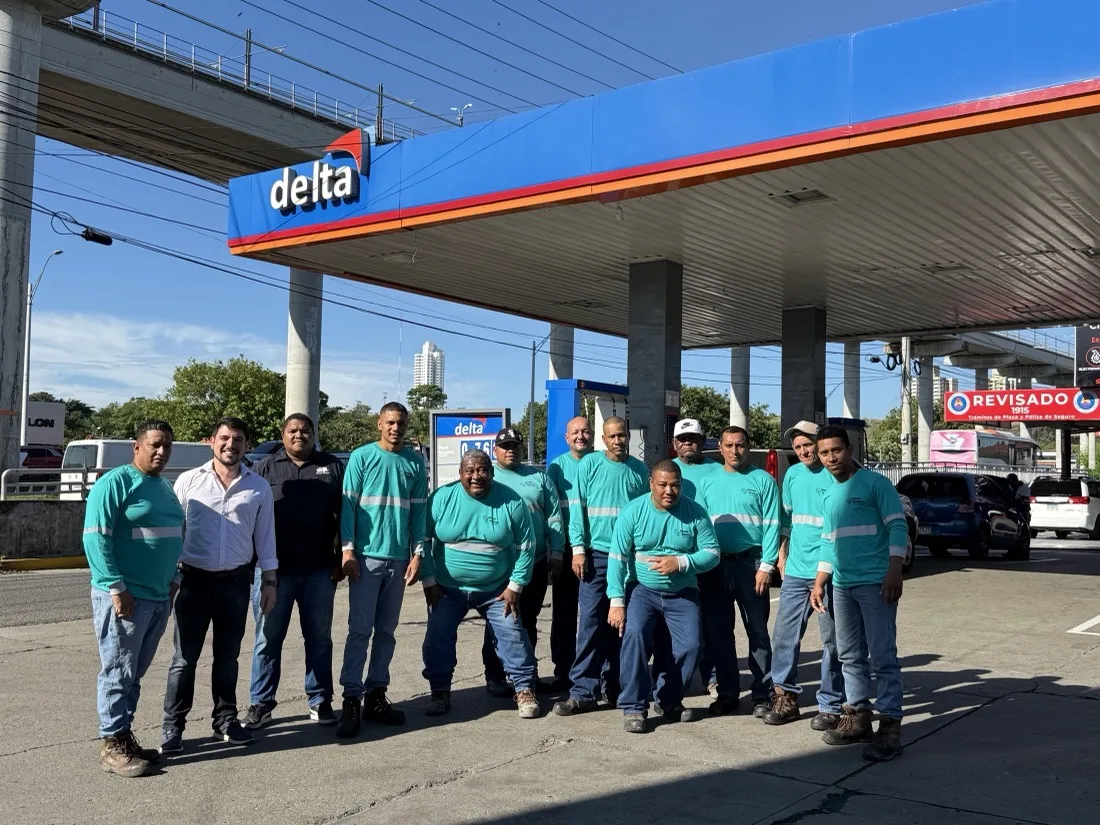
We have carried out service orders at stations of chains like Delta, Texaco, Puma and Terpel since 1978. At Delta Galápagos we replaced underground tanks at an operating station — the kind of intervention that a maintenance program with a baseline and a logbook anticipates, rather than improvises.
Related services
Two of these blocks have their own field process. For the dispenser block, see dispenser maintenance; and when a tank must be prepared before a test, a certification or a product change,tank emptying covers that sequence.
Decision facts
- Who it is for
- Fuel stations in Panama that need documented preventive and corrective work by subsystem, not a generic task list.
- Not for
- A universal-frequency package copied from another jurisdiction, or a certificate issued by the Fire Department or an ACODECO verification.
- Coverage
- Nationwide in Panama. Logistics are confirmed with the province and site access.
- Station operating
- Work is coordinated to avoid interrupting dispensing when the scope allows. Which equipment must go out of service is defined on site.
- What you get
- A baseline for each spill bucket, sump, probe and line, prioritized findings, a logbook for each visit and a schedule grounded in the installed equipment.
- How to quote
- Share equipment count, known condition, access and priorities. Duration is defined after the inventory.
- Office hours
- Monday–Friday 07:00–16:00; Saturday 07:00–13:00. Field work is scheduled per site.
Frequently asked questions
- What does station maintenance cover?
- Four blocks: underground tanks and lines, dispensers, electrical and control systems, and civil works and safety. The initial inventory identifies what exists before tasks are defined.
- Is there a universal maintenance frequency?
- No. The cycle depends on the installed model, manufacturer instructions, history, condition found and the requirements of that installation.
- Where do you start if there is no formal program?
- With a documented baseline: inventory of each component, prioritized findings with photos and, if there are critical items, repair before the preventive cycle.
- Does SNE certify station maintenance?
- No. Fire Department (DINASEPI) inspection and certification, ACODECO metrology and any environmental requirement must be kept distinct. The program does not assign those roles to a single authority.
- What information do you need to quote?
- Equipment count, known condition, access and priorities. Duration is defined after those facts are known; there is no long-term commitment without a baseline.