Wayne, Gilbarco and Tokheim for E10: an evidence-based comparison
How to compare dispensers by identification and documentation without declaring entire generations compatible or incompatible.

In this article
- 01The unit of analysis is the installed equipment
- 02What a manufacturer source proves
- 03A useful comparison
- 04Retrofit or replacement
- 05Regulatory status
- 06Comparing product families without turning the brand into the answer
- 07A matrix that prevents duplicate purchasing
- 08Total cost and maintainability
- 09Frequently asked questions
- 10Application record: dispenser comparison
A table assigning E10 compatibility by brand or decade looks convenient but hides the variables that change the decision: model, configuration, revision and replaced components.
The unit of analysis is the installed equipment
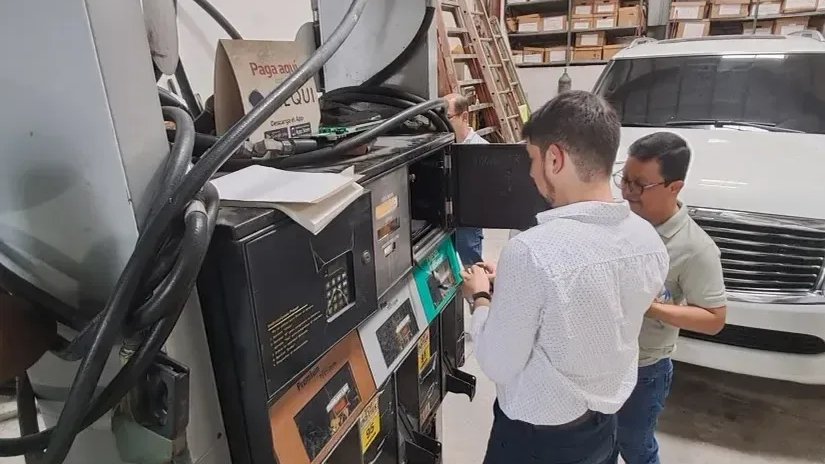
For Wayne, Gilbarco or Tokheim, record the nameplate, model, serial, options and components in the fuel path. Two units in the same family may have different meters, seals, hoses or kits.
What a manufacturer source proves
Documents from Wayne/Dover Fueling Solutions and Gilbarco contain statements for specific products and configurations. Cite them by name and edition. If a model is absent or does not match the installed revision, compatibility remains pending.
A useful comparison
Instead of one row per brand, compare by component: available identification, stated blend, applicable document, required actions and gaps. Separate the dispenser body from hoses, nozzles, breakaways, filters, meters and seals.
Retrofit or replacement
The decision depends on available evidence, condition, manufacturer support, kit scope and operator objectives. No universal year cutoff supports that decision without inspection and documentation.
Regulatory status
Resolution MIPRE-2026-0010986 suspended the planned implementation and voided the previous schedule. As of September 4, 2026, no new active date was located. The assessment supports evidence-based budgeting, not artificial urgency.
A responsible report delivers the matrix and sources used, and marks any unit that cannot be identified or documented as pending.
Comparing product families without turning the brand into the answer
Wayne, Gilbarco and Tokheim span multiple generations, markets and configurations. A useful comparison is not “brand A versus brand B,” but installed unit versus available evidence. For each dispenser, record the nameplate, hydraulic assembly, meter, filter, hose, nozzle, breakaway, swivels, valves and repair kits. A replacement part from another brand also needs its own documentation.
The Gilbarco ethanol-fuel manual and manufacturer data sheets support review of specific products. Do not extend a statement for one family to another or an approval from another jurisdiction to the entire fueling path.
A matrix that prevents duplicate purchasing
| Criterion | What to compare | Common error |
|---|---|---|
| Identity | Model, variant and serial | Using only the cabinet logo |
| Wetted path | Every part in contact with fuel | Checking only hose and nozzle |
| Source | Exact document and revision | Using a generic table without part numbers |
| Condition | Damage, leaks, swelling, corrosion | Confusing compatibility with good condition |
| Action | Keep, confirm, replace or test | Changing everything without priorities |
Connect the matrix with our Wayne-specific guide and E10 compatibility-assessment service.
Total cost and maintainability
The lowest-priced part does not always reduce cost. Assess local availability, traceability, downtime, tools, training and the ability to keep a stable part number. If a brand has clear documentation but the installed component is obsolete, the plan should identify an approved replacement.
The resolution published in the Official Gazette suspended Panama’s previous schedule. Recheck the framework before setting conversion dates and use the pause to complete evidence rather than declare compatibility without review.
Frequently asked questions
Which brand is best for E10?
There is no universal winner. It depends on documented configuration, support, condition and the asset’s total cost.
Can compatible parts from several brands be combined?
Only when each component and the combined configuration are approved or documented for the intended use.
Does visual inspection confirm compatibility?
No. It confirms condition and visible labels; compatibility requires documentation for the exact product.
Application record: dispenser comparison
Before applying this guide to a facility, identify each unit, its configuration and the parts actually installed. Write the decision as a verifiable question: which option provides documented compatibility and maintainable support. A recommendation without an asset, question and date is difficult to audit and may continue circulating after the facility has changed.
- Input: exact data sheets, condition, availability and total cost.
- Source: retain the title, issuer, edition or date, link and section used.
- Owner: assign who confirms data, who authorizes action and who verifies closeout.
- Status: use confirmed, pending, not applicable or out of scope; do not fill evidence gaps by assumption.
Retain the version that supported the decision and record differences between the plan and field conditions. If a part is substituted, the supplier changes or the fuel is updated, reopen the record instead of reusing the earlier conclusion. This keeps the article a working framework rather than a substitute for the manual, design, risk assessment or responsible authority.
Continue learning in Master University. To review a real case, share the inventory, legible photographs, objective and available documents through our contact page; a responsible technical recommendation begins with scope.