Fuel spill at a service station in Panama: what the rules require in the first hour and what comes next
What Panamanian rules require after a fuel spill at a station: one-hour report to MiAmbiente, soil limits, remediation plan and deadlines.

In this article
- 01The short answer
- 02Does every drop have to be reported?
- 03The first hour, step by step
- 04When a spill becomes "contaminated soil"
- 05How remediation works: what the standard prioritises and what happens in the field
- 06Liability: who answers, and what counts in your favour
- 07Before it happens: what you are already required to have
- 08Frequently asked questions
- 09The next step
- 10Official reference and limit of this guide
A spill at a service station starts two clocks at once. The first is physical: product moves through the soil and, if it reaches the water table or runs under the neighbour's slab, the remediation work multiplies. The second is regulatory, and it is shorter than almost everyone assumes: in Panama an environmental incident or accident must be reported to the authority within no more than one hour.
This guide is for station managers, maintenance leads and chain operators who need to know, with the rules in hand, what to do in that first hour, when a spill legally becomes "contaminated soil", and what process starts afterwards. It is not legal advice; it does cite each instrument with its Official Gazette (Gaceta Oficial) number so you can verify it.
The short answer
- Safety first. Cut the supply, remove ignition sources and isolate the area. A sump or an excavation with vapours is a confined space: nobody goes in without gas measurement and a procedure. If there is a fire or vapour risk, call the Fire Department (Cuerpo de Bomberos), which is responsible for handling hazardous-materials incidents.
- Stop the source and contain. Stop the transfer, block storm drains, recover free product. It is the only thing that changes the size of the problem.
- Document with photos and video that record date and time, the source and the measures you are applying.
- Report within the first hour if product left containment: the report goes to the Regional Office (Dirección Regional) of the Ministry of Environment (MiAmbiente) for the station's area, by email, phone or any other channel the ministry establishes.
- If the soil exceeds the limits of the soil quality standard, a regulated procedure begins: declaration, Remediation Plan, execution, final report and a closing resolution.
Does every drop have to be reported?
No. MiAmbiente Resolution DM-0427-2021 (Gaceta Oficial 29357-B, 20 August 2021) requires reporting environmental incidents and accidents; its definitions do not speak of a "spill" as such. A drip in the spill bucket that is contained and cleaned in minutes is not the same as product already in the soil or in a storm drain.
The rule we use is simple: if product left the containment system and touched soil, water or a drain, treat it as an environmental incident and report it. Over-reporting costs a phone call; under-reporting counts against you when the penalty is graded (see the liability section).
Three common station scenarios, from smallest to largest:
- Surface spill on the island or at delivery: product on the slab, not reaching natural soil. Contain with absorbents, collect the material as waste, log it internally.
- Product in a sump, spill bucket or drain: there is now a path to the soil or the sewer. Stop the source, remove the product, report.
- Inventory that does not reconcile, or product in the subsoil: a leak in a buried tank or line. Here the spill is continuous and time works against you; the priority is to confirm the source (a tightness test does that) and report.
The first hour, step by step
Safety and source
Before any paperwork: cut power to the affected island or system, stop the transfer, remove ignition sources and isolate the area. Vapours accumulated in a sump or excavation, or free product in quantity, make it a hazardous-materials incident, which Panama's Fire Department is responsible for attending (Law 10 of 2010, art. 3). A sump is also a confined space: measuring the atmosphere before entering is not optional.
Stopping the source is the only thing that changes the size of the problem. Everything else (absorbents, pumping, excavation) works on what already got out.
The report
Resolution DM-0427-2021 sets three things:
| What | Detail | Source |
|---|---|---|
| Deadline | No more than one hour from the moment the environmental incident or accident occurs | Art. 2 |
| To whom | The MiAmbiente Regional Office where the event occurred, immediately, by email, phone or any other channel the ministry establishes | Art. 5 |
| What to report | Identity of the responsible party, name of the project or works, description of the event (type, time, causes, possible effects, contaminants involved), exact location and the contingency measures being implemented | Art. 3 |
The same resolution requires documenting with photographs, video or other evidence that shows the date and time of the event (art. 4), and immediately informing the community and local authorities in the area of influence, in plain language (art. 6). In practice: whoever makes the call should have the station's registration, the detection time, the product (gasoline, diesel), an honest volume estimate and the measures under way.
This obligation does not stand alone: the consolidated text (Texto Único) of Law 41 of 1998 (General Environment Law, Gaceta Oficial 28131-A of 2016) imposes a general duty to report the occurrence of environmental disasters immediately.
Containment and documentation
With the source closed, contain: absorbents on the surface, storm-drain covers, free-product recovery from sumps and excavations. Removed soil and recovered product leave the station as regulated waste, not as ordinary refuse; that has its own law and we cover it below.
Documenting is not bureaucracy: it is what decides whether the case closes soon. Time-stamped photos, a sketch of where product appeared, ATG (automatic tank gauge) readings if you have them, recovered volumes. It is the same material the authority will ask for and the material you will need for the remediation plan.
When a spill becomes "contaminated soil"
Panama has a specific standard: Executive Decree 2 of 14 January 2009 (Gaceta Oficial 26230), which establishes the Environmental Quality Standard for Soils. It is the instrument that defines, in numbers, when soil is contaminated with hydrocarbons. The standard dates from 2009 and names ANAM as the authority; today that role belongs to MiAmbiente.
The limits (LMP)
Article 18 sets maximum permissible limits (LMP) for human health by soil-use category: industrial use, urban use and other uses. For total petroleum hydrocarbons (TPH), the parameter that defines most station cases, the limits are:
| Parameter | Industrial use | Urban use |
|---|---|---|
| Total petroleum hydrocarbons (TPH), mg/kg | 620 | 230 |
The same table sets individual limits, also by use category, for benzene, toluene, ethylbenzene and xylenes (BTEX); check them in the Gazette with your laboratory, because a soil can pass TPH and fail benzene.
Three warnings that prevent expensive mistakes:
- The limit depends on the use category. A report that cites "the TPH limit" without saying which category it is compared against is useless. Confirm the category that applies to your site before reading a lab result.
- No method, no comparison. The standard itself carries, in article 37, the table of laboratory methods and protocols. Two labs using different methods return different TPH values for the same sample; ask for the method along with the number.
- The values are the standard's limits for the stated category, not the cleanup targets of a specific project: each case's target is set by the approved Remediation Plan. TPH groups hundreds of compounds and is measured as a total, by fractions; BTEX are four specific compounds the standard regulates separately.
The standard sets limits for soil. It sets none for groundwater: if product reached the water table, a different instrument applies and you must confirm it with the authority and your adviser before writing the plan.
The declaration and the plan
When sampling shows values above the LMP, the standard triggers a procedure with deadlines in business days (días hábiles):
| Step | Deadline | Article |
|---|---|---|
| Declaration of the soil as contaminated and obligation to submit a Remediation Plan | — | Arts. 19-20 |
| Submission of the Soil Remediation Plan | up to 120 business days | Art. 22 |
| Evaluation of the plan by the authority (favourable or unfavourable opinion, or request for additions) | up to 90 business days | Art. 25 |
| Comments from sectoral environmental units and the municipal authority (silence is taken as no observations) | 60 business days | Art. 26 |
| Owner's response to the observations, then the final opinion | 30 + 30 business days | Art. 27 |
| Start of remediation after approval | up to 1 year | Art. 28 |
| Final Compliance Report on completion | — | Art. 29 |
| Lifting of the "contaminated" status | only by Resolution of the authority | Art. 31 |
The last row is the one most often overlooked: the soil remains "contaminated" until a resolution says otherwise. Excavating and backfilling does not close it: the file stays open and the station remains the responsible party.
The exact content of the Plan and of the Final Report is set by the authority through administrative resolution; confirm it with the Regional Office before drafting.
On sampling: the standard carries its own protocol (art. 34: 12 m² units, 9 to 12 sub-samples, 10 cm depth). It characterises the surface; it does not replace a subsurface investigation with boreholes at depth, which is what is needed when the leak comes from a buried tank or line.
How remediation works: what the standard prioritises and what happens in the field
Executive Decree 2 of 2009 has a declared preference: article 23 prioritises in situ remediation and bioremediation; article 24 admits containment as an alternative when those are not feasible. "Dig it out and haul it away" is not the standard's default option.
The methods you will see in a remediation plan. The definitions of the in situ methods are those of the U.S. EPA; the application notes are Master Services' field criteria:
- Excavation and disposal (ex situ). The affected soil is removed and treated or disposed of off site. Verifiable and quick for localised impacts; limited by structures, tanks in service and the volume that leaves as regulated waste.
- Soil vapour extraction (SVE). Vacuum extraction wells draw volatile and some semi-volatile compounds out of the unsaturated zone into a surface treatment system. Its performance depends on product volatility and, above all, on soil permeability and water-table depth: in clays or with a shallow water table it yields little, gasoline or diesel alike.
- Pump and treat. Contaminated groundwater is extracted and treated at the surface; it also serves to hydraulically contain the plume. The destination of the treated water requires its own permit.
- Bioremediation. Stimulates or adds microorganisms that degrade the hydrocarbon, in situ or in piles. It is the option the Panamanian standard names first.
- Multi-phase extraction (MPE). A vacuum system, sometimes with a downhole pump, that extracts contaminated water, free product and vapours at the same time; by drawing down the water table it exposes more of the formation to vapour extraction, and the phases are separated and treated at the surface. It is the technique designed for free product on the water table.
The choice depends on the product (gasoline vs. diesel), on whether there is free product, on water-table depth and on whether the station keeps dispensing during the works. A serious plan explains why it chose the method.
The soil that leaves is regulated waste
Law 6 of 11 January 2007 regulates oily waste derived from hydrocarbons and, in its article 1, "material contaminated with hydrocarbons and their derivatives"; the reasonable reading is that excavated soil carrying product falls within that scope. What the law sets for that material:
- It prohibits disposing of it in soil, surface or ground water, septic systems and sewers.
- The generator may store it for a maximum of ninety calendar days before treatment or final disposal, labelled as a hazardous product.
- Records must be kept, in four copies, of quantities, dates, origin, carrier and destination.
- Whoever transports the waste must be registered with the National Directorate of Hydrocarbons and Alternative Energies (Dirección Nacional de Hidrocarburos y Energías Alternativas) of the Ministry of Commerce and Industries (MICI).
- The site that receives and treats the waste needs a sanitary permit from the Ministry of Health (MINSA), a recycling permit from MICI and an environmental impact study (or, failing that, an environmental adjustment and management programme).
- There is no single registry of "waste managers" at MiAmbiente to rely on; you have to ask each supplier for its specific permits.
Keep those records: they are the proof that the waste left through the right channel.
Liability: who answers, and what counts in your favour
Using the numbering of the consolidated text of Law 41 of 1998:
- Art. 103: whoever causes environmental damage is obliged to repair it and to compensate.
- Art. 104: liability is strict: no need to prove fault; damage and a causal link are enough.
- Art. 105: generators of hazardous waste are jointly and severally liable with those who transport and handle that waste, at every stage, including final disposal. Choosing the wrong hauler for your soil means taking on their problem.
- Art. 111: the penalty is graded by severity, recidivism and the conduct of the responsible party after the event.
That last article answers the most common objection ("if I report, they punish me harder"): the law takes into account how you acted after the event. The consolidated text sets no fine figure that can be quoted; any amount you see published should be checked against the law in force. Environmental liability also has its own criminal track, which we do not cover here.
Before it happens: what you are already required to have
Contingency plan. Executive Decree 2 of 2024 (Gaceta Oficial 29998-B), which regulates the environmental impact assessment process, lists service stations (ISIC/CIIU code 47300, the economic-activity classification) among the activities subject to an Environmental Impact Study (EsIA), and makes the Contingency Plan (item 9.6) mandatory in categories I to III. If your plan is the one filed with the original EsIA, it probably does not describe the station you operate today.
Sumps and spill buckets. The EPA notes that many releases at underground-tank sites originate in delivery spills and overfills, and recommends inspecting sumps and spill buckets on a regular basis. No rule sets the frequency. At Master Services we recommend a monthly check and immediate drainage of any accumulation. How to do it: sumps and spill buckets: inspection, drainage and prevention.
Tightness. A leak in a buried tank or line cannot be seen; it is detected through inventory, the ATG or a tightness test. What those tests measure and when to run them: tightness testing in Panama.
Frequently asked questions
Do I have to report a small spill I cleaned up in minutes?
The resolution requires reporting environmental incidents and accidents, not every drip contained on the slab. If product touched natural soil, water or a drain, report it: conduct after the event is a grading criterion for the penalty.
Is excavating and disposing of the soil what the standard asks for?
Not as a first option. Executive Decree 2 of 2009 prioritises in situ remediation and bioremediation, and admits containment as an alternative. Excavation is valid when the plan justifies it.
Who is allowed to haul contaminated soil?
A carrier registered with MICI's National Directorate of Hydrocarbons and Alternative Energies, bound for a site holding MINSA, MICI and EsIA permits. Ask for the documents before loading the truck: the generator is jointly liable for what the hauler does.
When does the soil stop being "contaminated"?
When the authority lifts the status by resolution, after the Final Compliance Report. Neither excavation nor backfilling closes it on its own.
Whom do I call first: the Fire Department or MiAmbiente?
If there is a fire or vapour risk, the Fire Department; the report to the MiAmbiente Regional Office has to go out within the first hour regardless. They are not exclusive: one person handles the emergency and another makes the report call.
The next step
The part of the problem Master Services handles at the station is the part that decides the rest: confirming the source with a tightness test, repairing or replacing the tank, line, sump or equipment that failed, and leaving documented what the authority will ask for. Soil remediation is carried out by a specialised firm; with the source closed and the evidence in order, that plan is written on data, not estimates.
If you have product in the ground or inventory that does not reconcile, request an on-site assessment. What our spill response covers: containment and repair after a fuel spill.
Official reference and limit of this guide
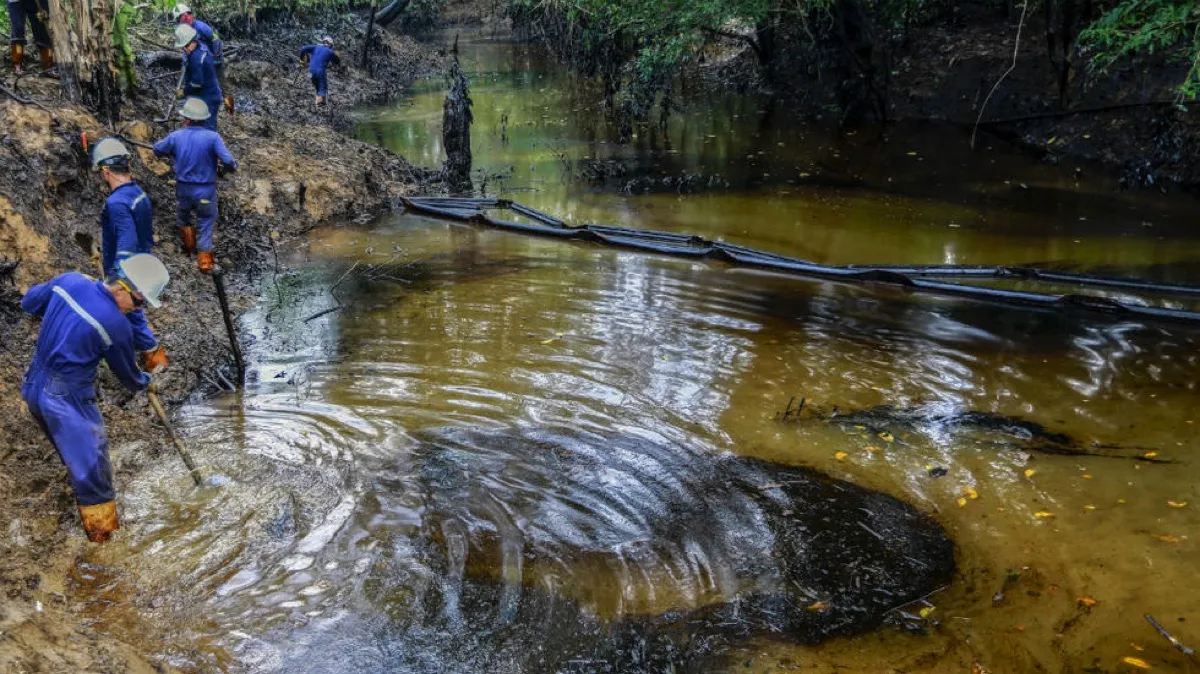
As a public example of institutional action, MIAMBIENTE documented an investigation following a reported fuel spill in Capira. The case shows that the authority may inspect, sample, and coordinate actions according to the site and potential impact; it does not by itself establish one universal deadline or protocol for every station.
This guide organizes initial questions and evidence, but it does not replace the facility contingency plan, HSE assessment, or directions from competent authorities. To define a technical scope for a specific site, review the spill-remediation service and share only information that can be verified.