Skip to content

January 27, 2026

Oil/water separator (API separator) at fuel stations: operation, cleaning, and MIAMBIENTE compliance

Rodolfo Ortega

By Rodolfo Ortega

Technician

Oil/water separator (API separator) at fuel stations: operation, cleaning, and MIAMBIENTE compliance

The oil/water separator — also called an API separator (after the American Petroleum Institute that standardized its design) — is the component that most often triggers a MIAMBIENTE investigation at Panamanian stations. Not because it fails dramatically, but because it becomes saturated silently and ends up discharging hydrocarbons into the storm sewer without anyone noticing until an inspector or a neighbor reports the smell. It is required by MIAMBIENTE; ignoring it does not stop operations today, but it creates tomorrow's environmental liability.

This article explains what it does, how it operates, what the correct maintenance schedule is in Panama, and what happens when it is ignored.

What it is and why it exists

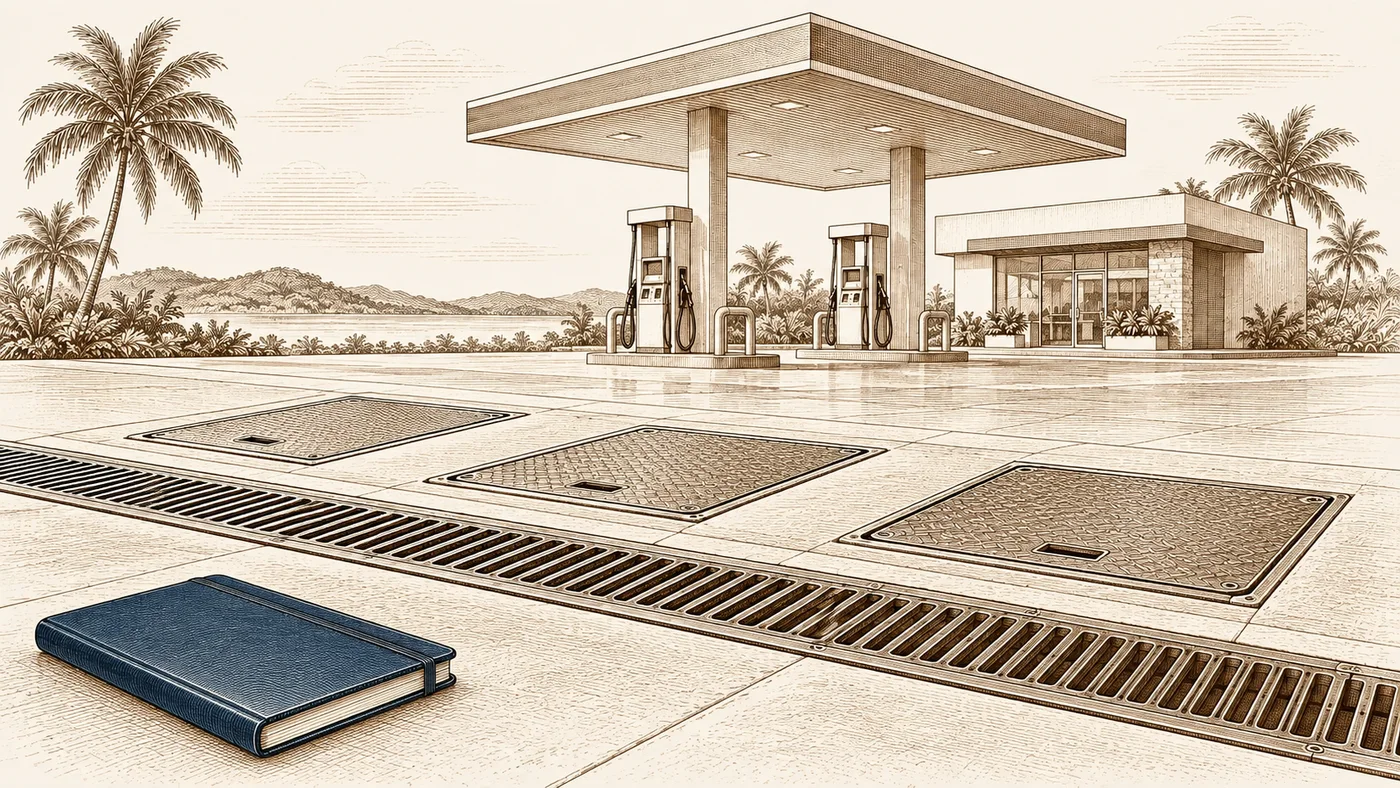
A service station has a dispensing slab (where the islands and dispensers are) that gets wet with:

  • Fuel drips during dispensing (all dispensers drip micro-amounts).
  • Fuel spilled by customers who overfilled their tanks.
  • Motor oil from vehicles dripping onto the slab.
  • Rainwater that mixes with all of the above.
  • That mixture cannot be discharged directly into the storm sewer: it is a regulated waste.

    The oil/water separator solves the problem through gravity separation:

    1. The water + product + sediment enters the separator.
    2. By density difference, the hydrocarbons (lighter) float to the surface.
    3. The sediment (dirt, rust, particles) settles to the bottom.
    4. The "clean" water remains in the middle layer and discharges into the storm sewer.
    5. The hydrocarbons at the surface and sediment at the bottom stay inside until cleaning is performed.

    It is physically simple. But it requires periodic maintenance: if the hydrocarbon layer grows too large, it eventually overflows into the sewer.

    Typical components

    A standard API separator has:

    | Component | Function |
    |—|—|
    | Inlet chamber | Receives water from the slab, reduces flow velocity |
    | Separation baffles | Force the flow to pass below the level of floating hydrocarbons |
    | Hydrocarbon retention chamber | Where the floating product accumulates |
    | Sedimentation chamber | Bottom where solid particles settle |
    | Outlet chamber | Treated water that goes to the storm sewer |
    | Sampling point | To verify the quality of the outflow water |
    | Access lids | For cleaning and inspection |

    In Panama, the typical material is reinforced concrete (high durability, low maintenance) or high-density polyethylene (lighter, quick installation). Common capacities for stations: 1,500 to 6,000 gallons.

    Recommended cleaning frequency

    The frequency depends on three factors: the station's traffic volume, the climate (rainy vs. dry), and events (recent spills, civil works).

    For a typical Panamanian station:

    | Station traffic | Recommended cleaning |
    |—|—|
    | Low ( 1,500 vehicles/day) | Every 3-6 months |
    | Station with events (spill, construction) | Additional cleaning post-event |

    Events that accelerate the need for cleaning:

  • Sustained torrential rain (carries extra sediment).
  • A spill on the slab that reached the separator.
  • Nearby civil works (dirt enters the system).
  • Frequent heavy-vehicle traffic (more oil drips).
  • Signs that cleaning is overdue

    Before the separator overflows, there are signs:

    1. Hydrocarbon smell near the separator

    If passing near the separator you notice a strong gasoline/diesel/oil smell, the floating layer is very thick.

    2. Visible layer when opening the inspection lid

    Visual inspection: if the hydrocarbon layer exceeds 5-10 cm in thickness, it should be cleaned soon. If it exceeds 15 cm, immediately.

    3. Outflow water not clear

    If the water discharging into the storm sewer is brown/reddish or has a visible oily sheen, the separator is saturated.

    4. Visible sediment in the outlet chamber

    The outlet chamber should be clean. If it has accumulated sediment, the internal baffles are not containing it correctly.

    5. Reduced retention time

    If you compare how long the slab water takes to reach the sewer vs. when the separator was clean, a shorter time indicates that the separator is "barely separating."

    6. Smell in the nearby storm-sewer area

    If the municipality or neighbors report a hydrocarbon smell in the storm sewer near the station, the problem is already discharging outside.

    Correct cleaning process

    Cleaning is not "open the lid and flush with a hose."

    Step 1: Prior notice to MIAMBIENTE (in some cases)

    For high-capacity stations or major cleanings, prior notice may be required. Confirm with an environmental advisor.

    Step 2: Appropriate equipment

  • Vacuum truck with capacity appropriate to the volume.
  • Personnel with full PPE (gases can be explosive).
  • Transport containers labeled as hazardous waste.
  • Documentation from an authorized MIAMBIENTE waste handler.
  • Step 3: Extraction of the floating layer

    First vacuum the top layer (hydrocarbons) into a separate container. This is the most valuable waste (it can be partially recovered) and the most regulated.

    Step 4: Extraction of the intermediate layer

    Vacuum the intermediate water: it can go to an authorized treatment plant or to re-processing.

    Step 5: Extraction of bottom sediment

    Vacuum the accumulated sediment: usually sludge with particles, rust, dirt, organic residue.

    Step 6: Internal cleaning of the separator

    Wash the walls and baffles with water. The dirty water is vacuumed as well.

    Step 7: Post-cleaning inspection

    Verify:

  • Baffles undamaged.
  • Walls without cracks.
  • Lids with seals in good condition.
  • Sampling point accessible.
  • Step 8: Initial recharge with clean water

    Partially refill with clean water to "prime" the system: it facilitates the initial separation.

    Step 9: Documentation + delivery of manifests

  • Date of cleaning.
  • Volume extracted by type (hydrocarbon, water, sediment).
  • Authorized handler who received the waste.
  • Manifest signed by the handler and operator.
  • Photo of the separator before and after.
  • This record is kept for at least 5 years and is the first thing MIAMBIENTE requests in an inspection.

    Consequences of omitted maintenance

    When a station has operated with a saturated separator for months (without cleaning):

    Operational

  • Persistent odors in the dispensing area.
  • Eventually, blockage of the slab drainage (ponding during rain).
  • Environmental

  • Discharge of hydrocarbons into the storm sewer: affects receiving water bodies.
  • Possible contamination of the nearby soil if the separator leaks externally.
  • Regulatory

  • Fines for uncontrolled discharge (depends on magnitude and duration).
  • Operational suspension if MIAMBIENTE determines acute risk.
  • Mandatory remediation plan if drainage or soil is contaminated (see remediation protocol).
  • Reputational damage if the case escalates to the press.
  • Economic

  • Emergency cleaning (with saturation) costs several times more than a preventive cleaning.
  • Repairs if the internal baffles collapsed from overload.
  • The cost of an environmental assessment to certify that there was no external contamination.
  • Correct vs. deficient design

    Some Panamanian stations operate with undersized or poorly designed separators. Symptoms:

  • Insufficient capacity for the drained slab area (slab area × rainfall > separator volume).
  • Poorly positioned internal baffles (flow short-circuit).
  • No accessible sampling point.
  • No easy access for cleaning (requires heavy machinery every time).
  • A single lid instead of multiple access points (limits inspection).
  • A station with a deficient separator can be cleaned perfectly and still not fulfill its function. The solution is replacement or re-engineering, not more cleanings.

    Correct sizing for Panama (rainfall of 100+ mm/h at peak):

  • Slab area < 200 m²: 1,500-2,000 gallon separator.
  • Slab area 200-400 m²: 3,000-4,000 gallon separator.
  • Slab area > 400 m²: 5,000+ gallon separator.
  • These are guideline ranges: the exact calculation is done by a sanitary engineer based on the actual drainage plan.

    Integration with the station's environmental plan

    The separator does not operate in isolation. It is part of the environmental management plan that MIAMBIENTE requires of every station. The plan includes:

  • Inventory of areas that drain to the separator.
  • Schedule of programmed cleaning.
  • Procedures for spill response.
  • Authorized handlers contracted or pre-qualified.
  • Training of personnel.
  • Logbook of related events.
  • A station that operates without a documented plan or with an expired plan is vulnerable in any inspection. Plan updates are typically annual.

    Specific Panamanian cases

    Urban station in a dense area

  • Storm sewer connected to the municipal network: a deficient separator discharge affects neighbors and the municipal network.
  • More frequent municipal inspections.
  • Cleaning every 4-6 months recommended.
  • Peri-urban or rural station

  • Discharge may go to a stream or natural water body.
  • MIAMBIENTE inspection may be more spaced out, but the consequence of a problem is greater (ecosystem impact).
  • Cleaning every 6-8 months recommended + monitoring of the receiving body.
  • Station with a car wash service

  • The volume and composition of the waste changes (more detergents, more sediment).
  • Separator potentially undersized for this additional load.
  • Cleaning every 3-4 months + possible separator upgrade.
  • Station with a mechanical workshop

  • Additional used oil + potentially solvents.
  • A standard separator does not capture solvents (nor should it: those go to separate management).
  • A specific environmental plan for workshop waste.
  • Frequently asked questions

    Can the station's staff do the cleaning?
    No. Cleaning requires a vacuum truck + PPE + regulated containers + an authorized handler. It is a specialized contracted service.

    How much does a cleaning cost?
    The cost varies with the separator volume, the authorized handler contracted, and waste disposal (the extracted hydrocarbons are not "trash"; they are regulated waste with a separate management cost). A service quote is requested from an authorized MIAMBIENTE handler.

    Are there separators that require no cleaning?
    No. All separators accumulate waste by design. "Self-cleaning" or "maintenance-free" ones are marketing: there is always a component that requires periodic attention.

    What happens if MIAMBIENTE inspects me and the separator is in bad shape?
    It depends on the state. If it is full but contained: an observation and a mandatory cleaning plan. If it overflowed into the sewer: a fine + remediation plan + possible operational suspension. If there is demonstrated contamination of the receiving body: a remediation plan + civil liability with neighbors.

    Does cleaning the separator interfere with normal operations?
    Minimally. The dispensing slab can get wet normally during the cleaning; the flow is only interrupted briefly. A typical cleaning takes 2-4 hours and the station operates during the process.

    Is the separator connected to the tightness test?
    Not directly. tightness tests fuel tanks and lines. The separator is part of the environmental system, inspected by MIAMBIENTE.

    Conclusion

    The oil/water separator is the environmental component with the most predictable maintenance cycle of any station: periodic cleaning, documentation, an authorized handler, a logbook. Whoever keeps it up to date arrives at a MIAMBIENTE inspection with a folder, not a problem. The cost of omitting it — fine, remediation, environmental assessment — bears no comparison with that of maintaining it.

    If you want an assessment of the current condition of your station's separator, a documented cleaning schedule, or assistance updating your environmental management plan, contact Master Services.

    Frequencies, capacities and costs mentioned in this article are referential, based on industry practice in Panama. Each station has specific parameters (slab area, traffic, local rainfall) that determine the exact schedule.