Operations & maintenance
Fuel dispenser maintenance
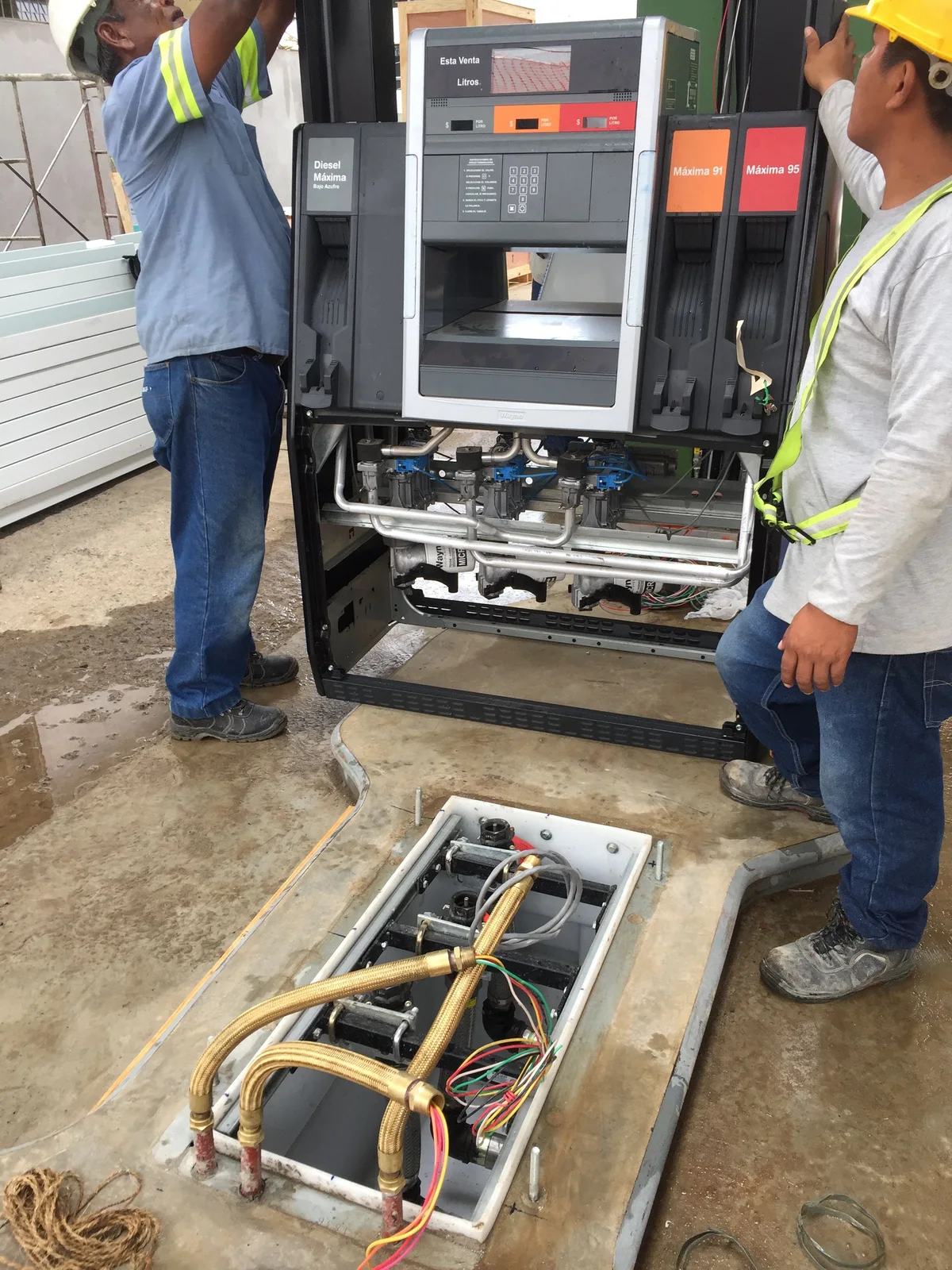
Fuel dispenser maintenance keeps the equipment inside a program of review and attention, reduces repeated failures and makes clear when calibration, diagnosis or a broader job is needed. At a station, the dispenser is the most visible and highest-rotation asset. That is why it should be served with a baseline, a history and a defined frequency — not just when a pump stops.
Master Services has worked on fuel-station infrastructure construction and maintenance in Panama since 1978. The experience includes work on Wayne dispensers, Veeder-Root ATG consoles, INCON systems and OPW equipment, plus coordination with networks such as Delta, Texaco, Puma and Terpel.
What fuel dispenser maintenance covers
The service starts by identifying what equipment you have, how it is operating and what problem you want to solve. A dispenser may need preventive maintenance, corrective attention, verification of a repeated failure or coordination with another station service. The proposal must separate those activities so the operator knows what is reviewed, what is adjusted and what remains pending.
The survey also considers the relationship between the dispenser and the ATG console. When Veeder-Root or INCON equipment exists, the information available from the system helps order the diagnosis. At a station with Wayne or OPW equipment, model, condition and history determine the scope. Not all dispensers should receive the same calendar-driven intervention.
Maintenance and calibration do not mean the same thing. Maintenance seeks to preserve and service the equipment; calibration verifies the dispensed measurement within the applicable procedure. If you need to verify volume with a certified prover, within the tolerance required by ACODECO, see the dispenser calibration service and do not mix that result with a simple maintenance visit.
Dispenser maintenance and the full station
The dispenser is part of a broader operation. A program that only serves dispensers leaves three blocks unmonitored. When the station needs a full review, the next step is full fuel station maintenance, which brings together the overall view of the facility. This page concentrates on the dispensing equipment, its history and its coordination with operations.
There are also jobs that change the program's priorities. An E10 conversion may require reviewing the maintenance scope and equipment condition; a MESA 2D test may require coordinating tank information and micro-leak detection; a calibration may reveal a deviation that must enter the plan. In those cases, link maintenance with E10 ethanol readiness and the MESA 2D test instead of treating each activity as an isolated order.
If you are comparing maintenance companies for gas stations or looking for maintenance contracts, ask them to explain the frequency criterion, the per-equipment scope and the closing evidence. The price of a visit does not say what is covered. The contract must be readable alongside the station's history.
Standards, calibration and traceability
The program is reviewed against the equipment and the goal. References may include NFPA 30 and NFPA 30A, and the applicable ACODECO, DINASEPI, SNE and MIAMBIENTE frameworks. Resolution numbers must not be copied without official confirmation. Documentation must say what was observed, what was executed and what activity requires follow-up.
Frequencies are not invented by the provider. They are set from dispenser throughput, failure history, equipment condition, the relationship with the ATG console, product changes and calibration or diagnostic results. The following table helps organize the conversation without turning a generic figure into an obligation for every station.
| Factor that defines frequency | How it affects the program |
|---|---|
| Throughput and level of use | A dispenser under heavier operational load may require closer follow-up. |
| Failure history | Repeated incidents justify examining the cause, not just correcting the symptom. |
| Model and associated system | Wayne, OPW, Veeder-Root and INCON may require different scopes and records. |
| Product change or E10 preparation | The conversion changes the condition and coordination questions for the equipment. |
| Calibration and testing | Their results can open a maintenance or diagnostic activity. |
Fuel dispenser maintenance process
- 01Survey and baseline. The station, dispenser, brand or associated system, reported symptom, available history and the operator's goal are recorded. Skipping the baseline is the most frequent mistake: without an initial reference, a repeated failure can look like a new incident.
- 02Scope definition. Maintenance is separated from calibration, the MESA 2D test, tank work and any comprehensive intervention. The scope states which equipment is served, what information is needed and what result must be verified.
- 03Scheduled intervention. The crew executes the agreed work on the included equipment, with the defined sequence and operating conditions. Tasks performed and any findings that change priority are documented. The record must make clear what was done — not close with a general phrase.
- 04Verification and documentation. The result is reviewed against the original reason for the order. When the problem requires a measurement, the activity is routed to calibration under the corresponding procedure. When it points to the tank or a possible micro-leak, the appropriate diagnosis is coordinated.
- 05Continuity plan. The next review, priority criteria and the information to be kept for the next visit are agreed. If the scope grows to the full facility, it moves to full station maintenance. The goal is for the next contract or order to start from history, not from zero.
Related dispenser work
These cases document dispenser replacements, a different scope from periodic maintenance. At Delta Costa del Este, four new dispensers were operating the next morning; at Delta Villa Lucre, the replacement was scheduled overnight to keep fuel dispensing available. To assess maintenance, identify which dispensers need attention and the faults observed. If the issue involves other station areas, request an assessment of the full facility.
Frequently asked questions
- What does fuel dispenser maintenance include?
- It includes the equipment survey, review of the problem or goal, scope definition, the agreed intervention and the closing record. The detail depends on model, condition, history and the relationship with the ATG console. If you need to verify volume, you must also arrange a calibration.
- How often should dispenser maintenance be done?
- Frequencies are not invented by the provider. They are defined based on throughput, failure history, equipment model, station operation, product changes and calibration or diagnostic results. An evaluation makes it possible to propose a program that can be sustained and documented.
- Do you service Wayne dispensers and OPW equipment?
- Master Services works on Wayne dispensers and OPW equipment, plus Veeder-Root and INCON ATG consoles. The scope is confirmed according to model, equipment condition and the goal of the visit. Share that information when requesting the evaluation.
- Does dispenser maintenance include calibration?
- Not necessarily. Maintenance addresses equipment upkeep and failures; calibration verifies the dispensed measurement. When appropriate, dispenser calibration is performed with a certified prover, within the tolerance required by ACODECO. See the dispenser calibration service.
- Does a maintenance contract for gas stations cover the whole station?
- It depends on the contracted scope. This page focuses on dispensers. If the contract must cover other areas, request an evaluation that connects both scopes with full-station maintenance.
- What changes if the station is preparing for E10?
- The product change can modify the condition, frequency and coordination questions of maintenance. It is worth reviewing the equipment within the E10 ethanol project, rather than treating the conversion as a separate dispenser visit.