Dispenser calibration in Panama: evidence and metrological control
What Acodeco verifies, which technical regulation MICI identifies and how to set frequency without inventing a universal schedule.

Head of Operations
About this image
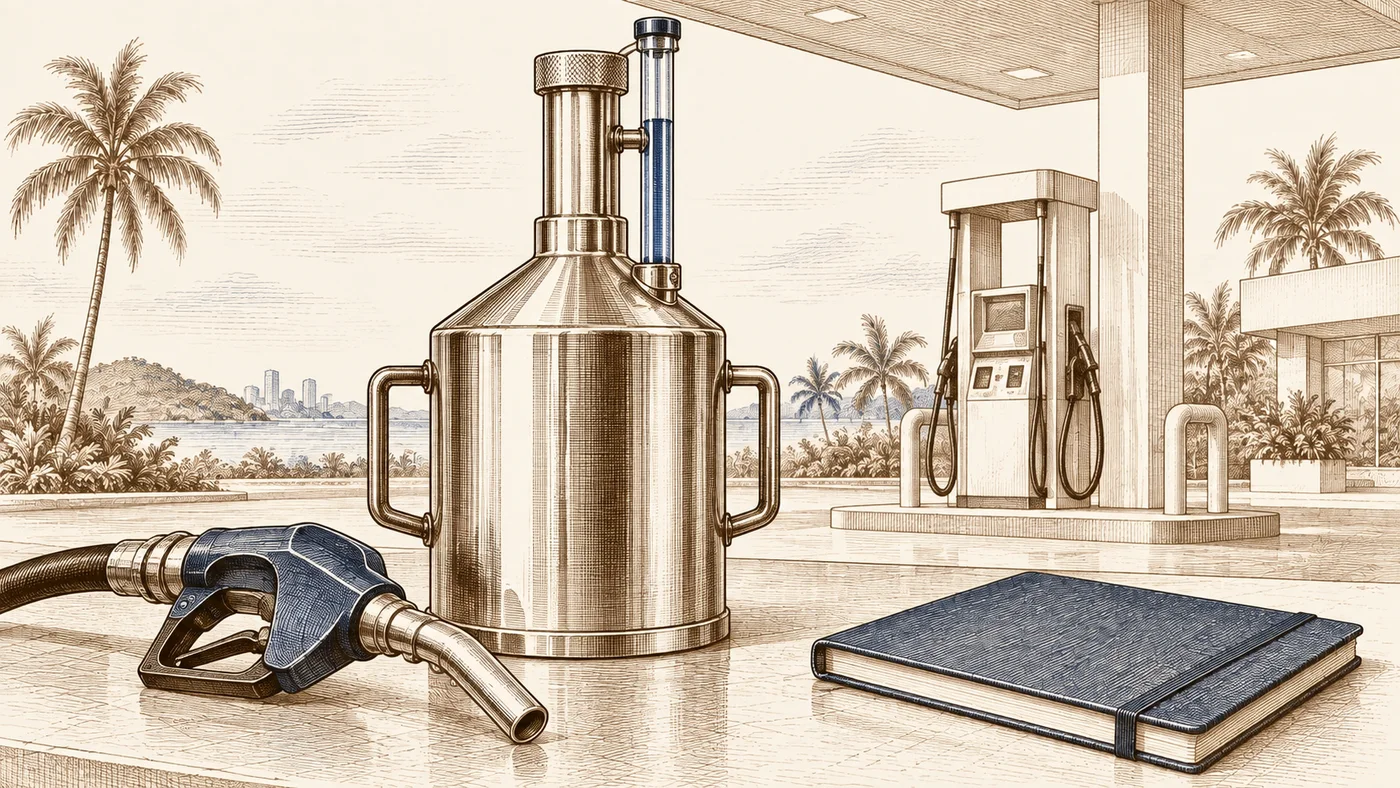
AI-assisted editorial illustration. Not a product photograph, installation drawing or test procedure; consult the applicable technical documentation.
In this article
- 01What the authority controls
- 02Identified technical regulation
- 03How to document calibration
- 04Evidence-based frequency
- 05Relationship to maintenance
- 06What happens before, during, and after verification
- 07Triggers that should not wait for the calendar
- 08Checklist for requesting service
- 09How to preserve record traceability
- 10Frequently asked questions
- 11Next step
Dispenser calibration should produce traceable evidence about delivered quantity and verification conditions. It is not enough for the unit to “look accurate,” and a universal frequency should not be published without an identified basis.
What the authority controls
Acodeco reports that it performs metrological checks at stations and reviews certificates, seals, prices and labeling, among other items. The concrete scope of a visit depends on the authority’s action and the inspected equipment.
Identified technical regulation
The MICI/DGNTI technical-regulation catalog includes RT DGNTI-COPANIT 51-2005 for liquid-fuel dispensers. Confirm the edition and any complementary instrument before stating a specific obligation.
How to document calibration
Record dispenser and side, meter, reference-standard identification, initial condition, checks performed, authorized adjustments, seals, result and responsible person. Keep the record with the date and equipment clearly identified.
Evidence-based frequency
We did not locate one official schedule that applies to every dispenser and situation in the sources consulted. The calendar should consider current requirements, certificate, manufacturer manual, history, use volume, interventions and findings. A deviation or altered seal triggers review even when it does not coincide with a calendar date.
Relationship to maintenance
Calibration does not replace review of filters, leaks, pulsers, hoses or electrical safety. See the Master University maintenance path to organize operational context before requesting service.
What happens before, during, and after verification
Calibration is a metrological check with an identified scope. Before measuring, the dispenser, side, and product are confirmed; during measurement, conditions and the reference standard are documented; afterward, the result and any authorized adjustment are recorded. This connects each reading to a specific unit and date.
| Stage | Control | Closeout evidence |
|---|---|---|
| Before | Identification, seals, visible condition, and available standard | Equipment and scope confirmed |
| Measurement | Indicated volume compared with the standard under recorded conditions | Readings and difference documented |
| Adjustment | Intervention only when appropriate and authorized | Traceable change and responsible person |
| Closeout | Post-adjustment check, sealing, and delivery | Record associated with the dispenser |
Triggers that should not wait for the calendar
A quantity complaint, repeatedly unusual reading, altered seal, meter repair, or difference observed during internal control justifies reviewing the equipment and defining the next step. This does not turn every signal into proof of miscalibration: the signal opens a check, and measurement determines the result.
The program must also separate calibration from dispenser maintenance. Replacing a filter or repairing a leak may be necessary, but it does not establish that the indicated volume is correct. Likewise, a compliant measurement does not prove the condition of every mechanical, electrical, or safety component.
Checklist for requesting service
- Identify the station, island, dispenser, side, product, and serial number.
- Share the latest available record and any later intervention.
- Describe the observed signal without turning it into a diagnosis.
- Coordinate access, the site contact, and allowed operating condition.
- Ask the closeout to separate initial condition, measurement, adjustment, and final result.
How to preserve record traceability
Associate the document with the serial number and exact dispenser side, not just the station name. Retain reference-standard identification and status, before-and-after readings, and any seal installed or removed. If a repair occurs later, link it to the record so the next technician can reconstruct the sequence.
A repeat check should also explain why it occurred: adjustment, concern about a reading, component replacement, or closeout verification. Repeating a measurement without recording the reason can create several apparently valid sheets without showing which one describes the current condition.
Do not use one generic record for several units without a breakdown. Each result must trace back to the dispenser, side, and condition that were actually checked.
Frequently asked questions
Are maintenance and calibration the same service?
No. Maintenance addresses equipment condition and failures; calibration compares the indicated quantity with an identified standard. They can be coordinated, but the report should distinguish both scopes.
Does an operational signal prove the dispenser is miscalibrated?
No. A complaint, inventory difference, or irregular flow can have several causes. Preserve the evidence first and then perform the appropriate check.
Who determines the applicable regulatory scope?
The competent authority determines its action and requirements. The technical provider identifies the equipment, performs the agreed measurement, and delivers evidence of that work without replacing the official decision.
Next step
To arrange fuel-dispenser calibration, gather the equipment identification and available history. If the symptom is still unclear, request an assessment before assuming which component needs adjustment.