How to tell if a dispenser is miscalibrated: operational signs and the prover test
How to distinguish operational indications from metrological verification and document dispenser testing under Panama’s current technical regulation.

Head of Maintenance Technicians
About this image
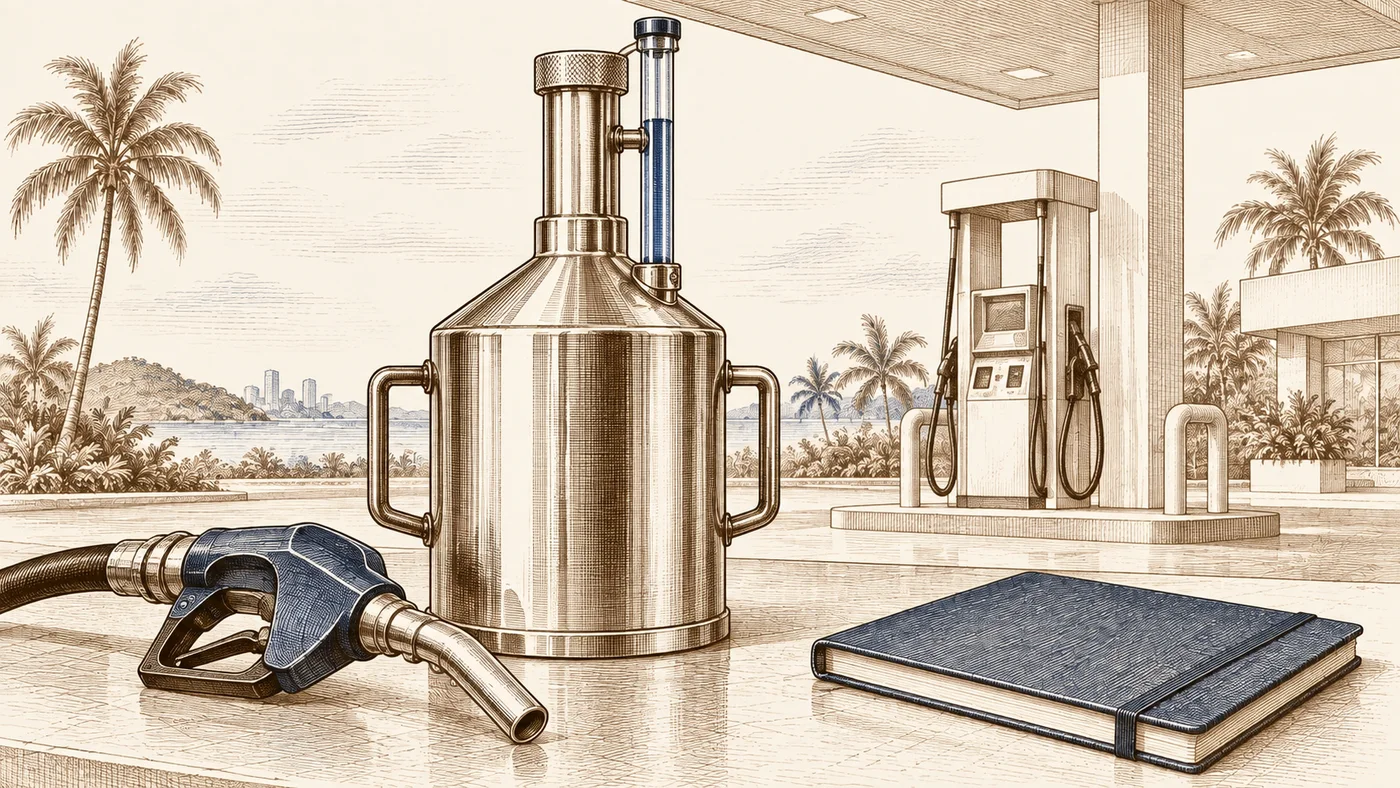
AI-assisted editorial illustration. Not a product photograph, installation drawing or test procedure; consult the applicable technical documentation.
In this article
An inventory difference, complaint or hose-specific pattern may justify a check, but it does not by itself prove that a dispenser is out of calibration. A metrological conclusion requires a standard measure, controlled conditions, a documented calculation and comparison with the applicable criterion. In Panama, the starting point is Technical Regulation DGNTI-COPANIT 51-2005 published by MICI.
What the Panamanian source requires
The official MICI technical-regulations list links the regulation for liquid-fuel dispensers. Section 8 calls for verification with a standard volumetric measure; states that calibration should not exceed three months; requires the service and technical staff to be accredited by the National Accreditation Council; and requires a copy of the latest calibration to be available. It also establishes zero control and a ±0.3% tolerance, expressed as three cubic inches in five gallons.
Applicability and later updates should be verified in the current source. Do not substitute a foreign tolerance or double the allowed error through an incorrect conversion.
Indications that justify a check
- Repeated complaints associated with the same hose or position.
- Persistent differences among sales, deliveries and tank variation after data review.
- Replacement of a meter, pulser, valve or another part that can affect measurement.
- Broken seal, undocumented intervention or an expired calibration record.
- Different results among positions serving the same product, confirmed under comparable conditions.
Each indication has other possible causes: tank chart, temperature, unrecorded delivery, loss, return, reading error or missing data. A standard-measure test isolates dispenser measurement; it does not solve the entire inventory balance by itself.
Documenting a verification
- Identify the facility, dispenser, side, hose, product and totalizer.
- Confirm that the standard measure and its traceability are suitable.
- Check zero, visible condition, absence of leaks and safe preparation.
- Run the measurements required by the applicable procedure and record volumes without premature rounding.
- Calculate error with consistent units and compare it with the Panamanian criterion.
- If adjusted, verify again, seal as required and retain before-and-after results.
A photograph of a prover is not enough. The record should show identification, date, results, standard equipment, responsible person and final status.
Calibration, enforcement and maintenance are different
Acodeco information on dispenser verification shows the authority’s metrological-enforcement role. An accredited provider performs the service within its scope, while the authority retains oversight. Mechanical maintenance corrects faults but does not replace post-repair calibration when an intervention affects measurement.
To integrate verification into asset management, see the dispenser-calibration service and our integrated-maintenance guide. File the certificate or report with the exact fueling position rather than only in a general station folder.
When a position is outside tolerance
Apply the site operating procedure and do not continue presenting the position as conforming. Preserve the initial result, diagnose the measuring assembly, document parts or adjustments and verify again. Do not break or replace seals without appropriate authority and competence. If several positions shift together, also examine the standard measure, procedure and conditions.
Frequently asked questions
Does an inventory difference prove miscalibration?
No. It is an indication to investigate together with tank, delivery, sales and possible-loss records.
What tolerance is published in Panama?
RT DGNTI-COPANIT 51-2005 publishes ±0.3%, equivalent to three cubic inches in five gallons. Always verify the current version.
Who may calibrate?
The published regulation requires the service and technical staff to be accredited by the National Accreditation Council; confirm the provider’s current scope.
Application record: metrological verification
Before applying this guide to a facility, identify dispenser, side, hose, product, totalizer and standard measure. Write the decision as a verifiable question: whether the position meets the Panamanian criterion under the applicable procedure. A recommendation without an asset, question and date is difficult to audit and may continue circulating after the facility has changed.
- Input: runs, calculation, traceability, seal and final result.
- Source: retain the title, issuer, edition or date, link and section used.
- Owner: assign who confirms data, who authorizes action and who verifies closeout.
- Status: use confirmed, pending, not applicable or out of scope; do not fill evidence gaps by assumption.
Retain the version that supported the decision and record differences between the plan and field conditions. If the measuring system is serviced, the record expires or the result changes, reopen the record instead of reusing the earlier conclusion. This keeps the article a working framework rather than a substitute for the manual, design, risk assessment or responsible authority.
Continue learning in Master University. To review a real case, share the inventory, legible photographs, objective and available documents through our contact page; a responsible technical recommendation begins with scope.